
New York's Difficulty Adjustment
A sermon of hope for New York City: trust the code that is as old as the stones
This article first appeared as the "sermon" on Plebchain Radio Ep. 136, recorded on Friday, Nov 7th, with guest Max Hillebrand
Listen to the full episode here
Listen to the sermon itself: https://fountain.fm/clip/2zCm9KlhEZTmAm5dKR21
Bear markets are for building. And urban decay is the fertile ground for cultural revolutions. Especially in the case of New York, a city I love – truly, madly, and deeply. It was my home for almost 20 years – I arrived as a boy, a short few months after 9/11 and became a man there. I got my fist job (and my second, third, and fourth), met my wife, fell in love … then fell in love again when my son was born. He grew up there, playing soccer in the public fields of Harlem. I’ve had to learn how to overcome severe adversity while I was there and also got to celebrate incredible triumphs.
For someone like me – unmoored for any single culture or country for most of my life – New York was the closest I ever came to finding home.
So today’s sermon, is one of hope in light on Mamdani’s victory in the mayoral elections earlier this week – a victory that has left a lot of my friends in despair.
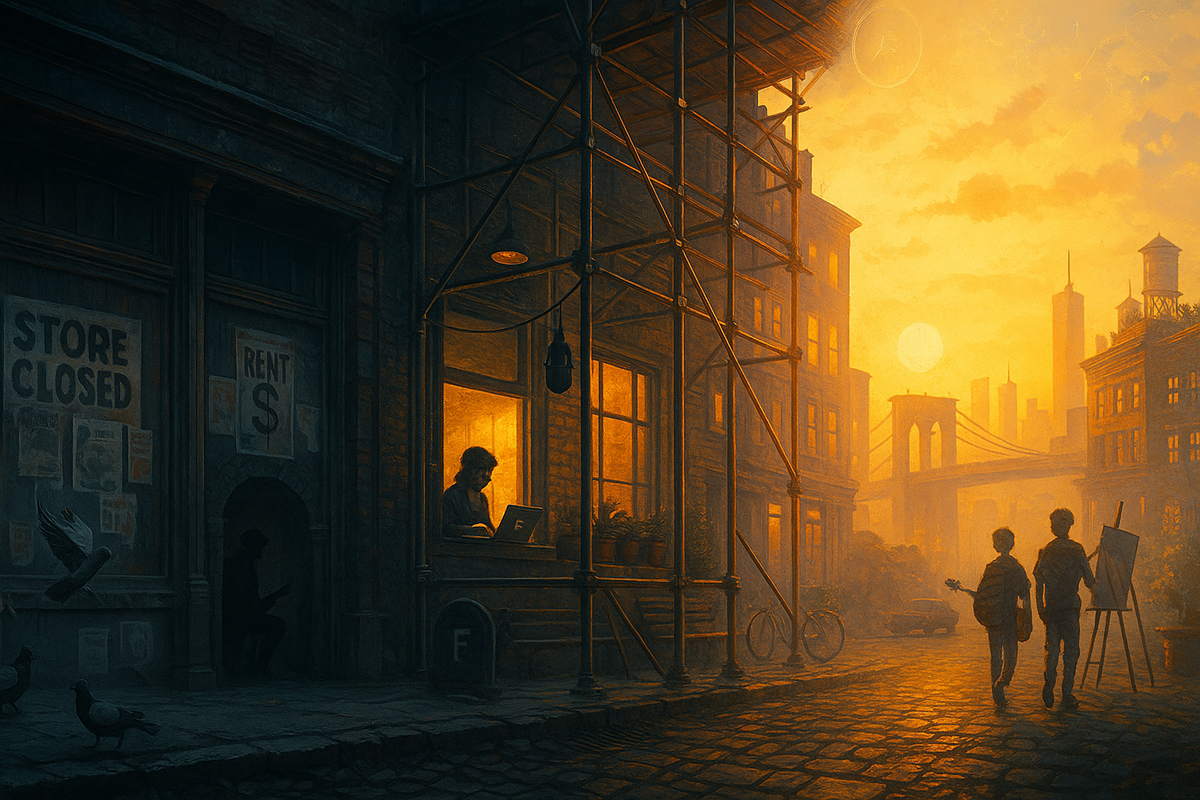
This is a city moves in long breaths, 30-to-40 year inhales and exhales – booms and busts. Booms bring glass towers, velvet ropes, and a glut of fair-weather wanderers, enamored by sterile and sanitized fiat opulence; busts brings plywood, pigeons, and rent cheap enough for a drummer, a coder, and a poet to split a railroad apartment … and accidentally invent the future.
History doesn’t repeat, it rhymes like a subway busker with two chords and a dream. After the Civil War came the gilded age of the late 1800s ... it brought the Brooklyn Bridge, the Metropolitan museum of Art and it also brought the bankers. Then came the crash of the 1890s and a long decay … which brought in the Harlem Renaissance, the jazz age, the New York subway – culminating in the roaring 20s.
After the Great Depression and the crash of 1929, the next decade and half of decay until the end of WW2 brought with it incredible theater and photography. It also laid the fertile ground for the Mad Men era that followed in the 50s and 60s. Then 1971 happened and the inevitable fiscal face-plant that followed – violence, arson, and looting were the norm. But that birthed punk, hip-hop, and a downtown that learned to speak in spray paint.
Then came the Guiliani-Bloomberg boom of the 90s and the early 2000s, which hit its first speed bump in the financial crisis of 2008. The decline didn’t become obvious until 2015 or 2016, but it has been slow, and almost inexorable since then.
But here’s the pattern – every time the money left, the muses moved in. It’s like the city has a built-in difficulty adjustment: when the block gets too rich to feel, it forks back to real.
So here we are in late-2025: I had hoped the pandemic would be the final nail in the coffin of this cycle. But I was wrong. Here’s how I think things will play out:
Mamdani will play the role of the final catalyst – first capital flight, then crime spike, then urban flight. Rents collapse and the creatives move back in. Trust the difficulty adjustment. It is a story as old as the stones on Canal Street
By decade’s end, the renaissance shows up late and underdressed: basement galleries humming, warehouse theatres cracking open, rooftop podcasts – why, hello – and a thousand micro-scenes stitched together by lightning payments, open protocols, and the oldest network of all: word of mouth. The city won’t be saved by any politician; it’ll be saved the old way – by kids with cheap rent and unreasonable confidence.
So, builders: sharpen your chisels. Writers: steal a table by the window and pay in sats. Musicians: tune to the hum of the F train. When the boom forgets what it’s for, the bust remembers. Bear markets are for building; busted cities are for birthing. And if history keeps rhyming, New York is about to clear its throat.