
Art's Hegelian Arc
From corseted classical beauty to nihilistic modernism, this piece argues we’re entering the "synthesis" period – a low-time-preference return to honest, enduring, and unapologetically beautiful art.
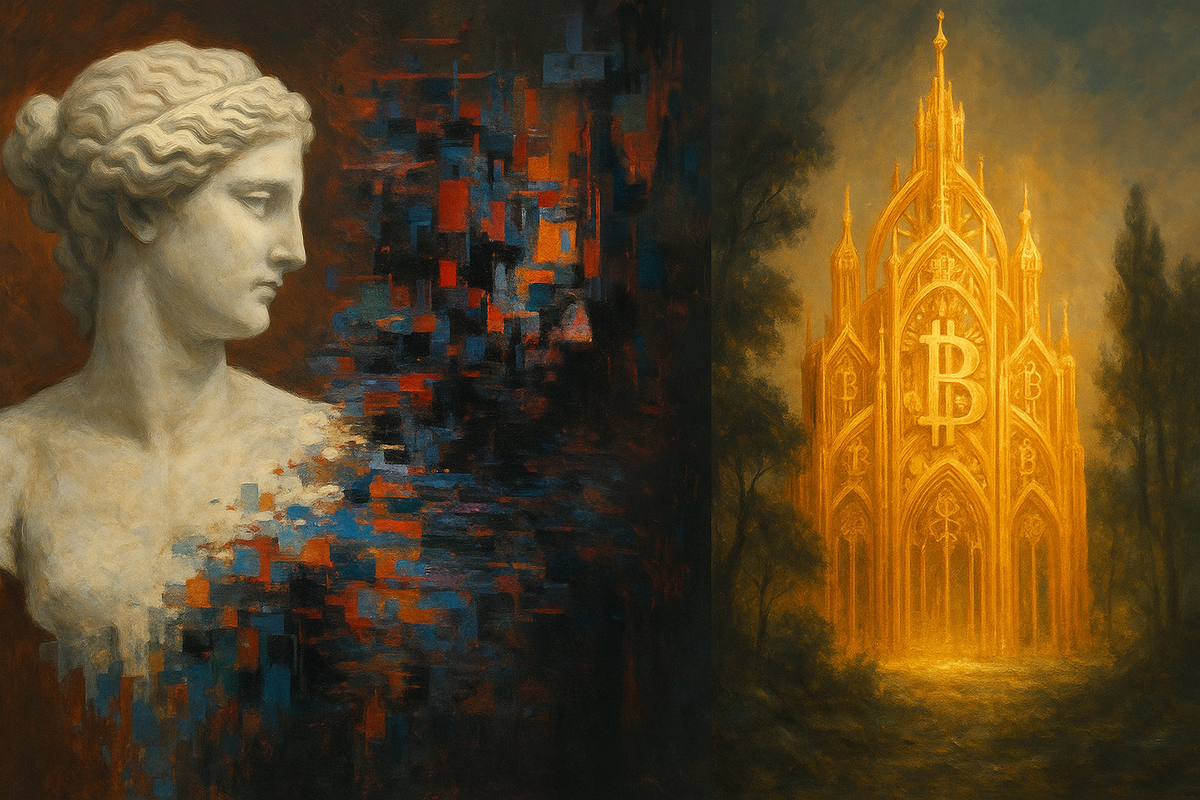
This article first appeared as the "sermon" on Plebchain Radio Ep. 137, recorded on Friday, Nov 14th, with guest Lady Block Jane
Listen to the full episode here
I want to talk about art – not as an academic exercise, but as a living thing that keeps trying to remember what it is.
If you zoom out, you can see a kind of Hegelian arc to the last couple of centuries. So, first, here is the thesis: call it classicalism, the long age leading up to about 1913. In that world, art was about the pursuit of beauty. Painters, composers, architects, poets – they were all in some way in service to the beautiful. But that beauty came wrapped in dogma. Rules about perspective. Rules about subject matter. Rules about who got to speak, and how. Beauty, yes – but beauty in a corset.
Then came the antithesis: modernism. At first, it kept the core principle of beauty but turned its attention to smashing the corset. Dali melting clocks, Breton’s manifestos, Buñuel’s razor slicing the eye of polite society. Art deco skyscrapers, French New Wave films cutting holes in narrative itself. It was a jailbreak. Modernism said, “If beauty is real, it doesn’t need a dress code.”
But something happened around 1971. The rebellion ossified into its own dogma. The cutting edge discovered that it was easier to destroy than to build, easier to sneer than to sing. The pursuit of beauty gave way to the performance of boredom, the cult of irony, the worship of nothing. We slid into late-stage modernism, where the highest praise you can give a work is that it “interrogates” something, preferably while being impossible to love.
That’s where we are now: surrounded by content, starving for beauty.
So what’s the synthesis?
The synthesis is what I call true post-modernism – not the academic word salad we’ve been sold, but a genuine third stage. A Bitcoin Renaissance. The dogma of classicalism is gone. The nihilism of late-stage modernism has burned itself out. What’s left is the possibility of a clean slate: a new, unbridled pursuit of beauty, built on hope, aspiration, and low time preference.
Low time preference means we plant trees whose shade we may never sit under. It means cathedrals and temples, not pop-up booths. It means songs and stories and films that might still matter in fifty years, not just for the algorithm’s next refresh cycle. Bitcoin is teaching us to think in those terms again – to build on bedrock instead of quicksand.
In this synthesis, we don’t go back. We don’t pretend the twentieth century didn’t happen. We keep the technical mastery of the classical, the experimental courage of the modern, and we throw away the fear, the despair, the cynicism, and the hollow irony. We dare to say, without embarrassment, that art should be beautiful, and that beauty should be true.
If money can be fixed, culture can be healed. And when culture heals, beauty comes roaring back.